Spatial audio and Dolby Atmos in music: what it is and how to listen
Music no longer comes only from left and right. Here is what changes when a track is mixed in Dolby Atmos.
- Spatial audio places sounds around and above the listener, not just between two speakers.
- Apple Music has offered spatial audio with Dolby Atmos since June 2021 at no extra cost; compatible tracks carry a badge.
- An Atmos mix is a new mix, separate from the stereo one, built from the tracks.
- On headphones the effect is a simulation: it works, but varies a lot from person to person.
For over sixty years almost all music was made for two speakers. In stereo every sound lives on a line between the left and right speaker: it can sit in the centre, to one side or somewhere between, nearer or further thanks to level and reverb. It is a simple system, and history’s great records were made inside it.
With Dolby Atmos the engineer can place each element as an object in three-dimensional space: in front, behind, to the side, above. Born for cinema, it reached music a few years ago, pushed above all by Apple Music. Let us look at what it is, how you listen to it and whether it is really worth it.
How Dolby Atmos works
In a traditional stereo mix each track feeds two channels. In Atmos there are two parts:
The bed. A base of fixed channels, as in a classic surround system, for sounds that need a stable position.
Objects. Individual sounds with a position in space described by coordinates, which can also move over time. The system decides how to reproduce them according to the setup you are listening on.
The advantage is that the same mix adapts: in a studio with many speakers, a living-room soundbar or a pair of headphones, the system “translates” the positions for what it has available.
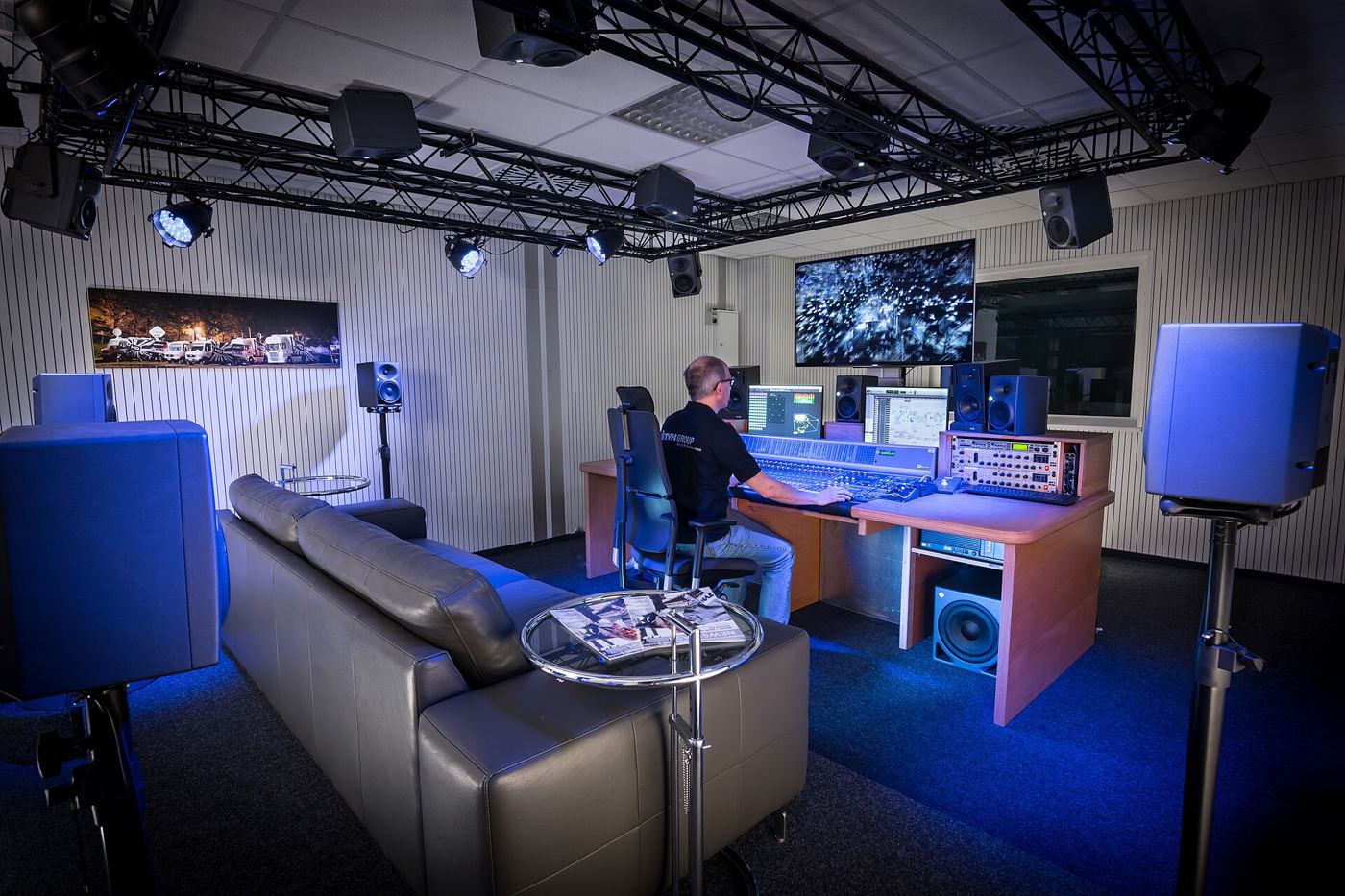
To mix in Atmos a studio usually uses seven speakers around, a subwoofer and four ceiling speakers. It is an expensive, specialised room, very different from a stereo control room.
How you listen
On headphones. The system simulates space with a calculation that imitates how the ears receive sound from different directions, called binaural rendering. On Apple Music it works with AirPods, Beats and other headphones. With some models there is also head tracking: turn your head and the sound stays put in space.
On speakers. You need compatible systems, such as soundbars or home cinema setups with Dolby Atmos.
On the platforms. On Apple Music, tracks available in Dolby Atmos carry a badge and there are dedicated playlists. Tidal and Amazon Music offer Atmos tracks too.
Atmos and stereo are not the same thing
An Atmos track is not the stereo version “widened”: it is a new mix built from the tracks. That means it can sound very different from the original: the vocal in a different position, instruments spread around, a changed balance.
Some songs gain a lot: orchestral music, ambient, detailed productions. Others sound scattered if space is used only to impress. Many artists and listeners find that some classics in Atmos lose the compactness that made them strong.
| Stereo | Dolby Atmos | |
|---|---|---|
| Space | between two speakers | around and above |
| Mix | one | a new, separate one |
| Listening | anywhere | headphones or compatible systems |
| Mix room | stereo control room | room with many speakers |
| Effect on headphones | direct | simulated, varies by person |
Why it does not convince everyone on headphones
Binaural simulation is based on how an “average” head receives sound. But everyone has different ears and heads, and the brain uses exactly those differences to work out where a sound comes from. If the simulation does not match your anatomy, the effect can feel unnatural: sounds that should be in front seem inside your head, or the tone seems changed.
Some services let you personalise the rendering, for example by scanning your ears with your phone. It helps, but does not solve everything.
Space is an effect until it serves the song. Then it becomes music.
For music makers: do you need an Atmos mix?
Pros: the track can be featured in dedicated playlists, and in some genres the experience really is more immersive.
Cons: it is a second mix, with an extra cost, done in an equipped studio. And most listeners will keep listening in stereo.
My advice: first make an excellent stereo mix. If the project justifies it, the Atmos mix comes afterwards, from the same tracks.
Three dimensions start in stereo
Even without Atmos a mix can have real depth: near and far elements, different planes, a scene that opens up. You build it with level, EQ, well-chosen reverbs and delays, and phase management. It is the work I do on every stereo song, and I talk about it in the articles on depth in the mix and reverb and delay.
Frequently asked questions
Do I need a special subscription for spatial audio? On Apple Music, no: it is included.
Is every song available in Atmos? No, only those that received a dedicated mix.
Can I turn it off? Yes, in the app settings you can choose to use it always, only with compatible headphones, or never.